Pathoverse Part 1: Introducing the Pathoverse
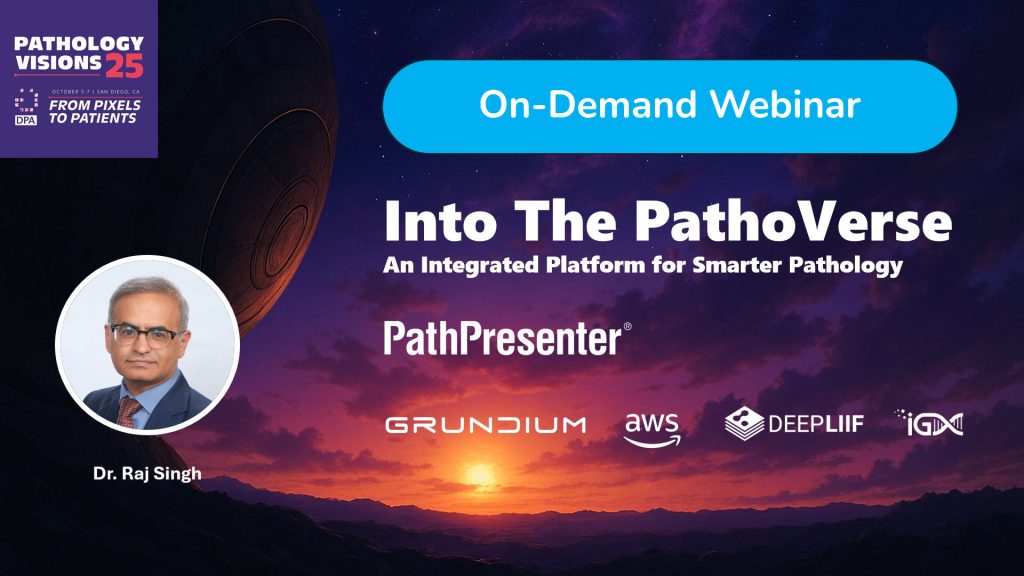
This article summarizes part 1 of our “Into the Pathoverse” webinar, recorded at Pathology Visions 2025 in San Diego and available on-demand. Watch the full video.
Every major innovation begins with a spark—a problem so persistent and universal that someone finally decides to solve it. For PathPresenter, that spark came from a challenge faced by pathologists everywhere: managing digital pathology images at scale.
In his opening segment of the Pathoverse webinar, Dr. Raj Singh described how the company emerged from his frustration as a practicing pathologist with the growing complexity of image management. Handling a handful of digital slides was easy. But as datasets grew, image formats multiplied, and systems evolved independently, turning those images into usable, accessible clinical assets became a major challenge. What pathologists truly needed, he argued, was a seamless environment where cases appeared when needed, workflows were smooth, and data interoperability happened quietly in the background.
That vision became the foundation of PathPresenter.
A Platform Built by Pathologists, for Pathologists
Dr. Singh emphasized that PathPresenter was never conceived as a technology-first company. Instead, it was built around deep domain knowledge and the lived experience of practicing pathologists. The team behind it—largely pathologists themselves—understood the daily frictions of digital pathology. Their goal was straightforward: create tools they would be proud to use in their own departments.
One of the platform’s defining characteristics is its agnostic design. PathPresenter supports virtually any scanner, AI algorithm, LIS environment, or storage setup. This flexibility reflects a simple reality: pathology labs operate with diverse systems, and forcing uniformity only creates new barriers.
This commitment has paid off. The open PathPresenter platform has grown to more than 70,000 users across 180 countries, with institutions uploading data from every type of scanner and imaging modality. In the U.S., more than 60 institutions now use the enterprise version of the platform for clinical, educational, and research workflows. This global scale has provided the PathPresenter team with unparalleled real-world experience in managing digital pathology data.
Filling Gaps in Digital Pathology
Throughout the webinar, Dr. Singh highlighted how PathPresenter has consistently focused on solving unmet needs in the digital pathology space. Early on, education emerged as a critical gap. In response, PathPresenter developed what has become one of the most widely used digital training platforms for pathology residents and fellows.
The company then expanded into remote consultations, building the first robust digital consult platform. Later came a biobanking module designed to help institutions unlock the value of their data by making it securely accessible to researchers, AI developers, and pharmaceutical partners.
Together, these components form an end-to-end ecosystem that supports:
- Clinical diagnosis and consultation through an enterprise case management system with an FDA-approved viewer
- Education and training through digital classrooms at more than 30 institutions
- Research and discovery through HIPAA-compliant biobanking and data-sharing tools
These capabilities now power multiple petabytes of managed data for major medical centers including MSKCC, Cincinnati Children’s, Summit Health, and leading diagnostic networks across Asia such as Dr. Lal PathLabs and Agilis.
Building an Interconnected Digital Pathology Ecosystem
Dr. Singh underscored a theme that ran throughout his presentation: no single organization can advance digital pathology alone. Progress requires meaningful collaboration across industry, academia, and clinical practice.
To that end, PathPresenter has built extensive partnerships with scanner manufacturers, AI companies, pharmaceutical organizations, and research institutions. This interconnected approach ensures that innovations don’t remain isolated in silos, but instead reach pathologists, oncologists, researchers, and even patients through real-world workflows.
AI is a prime example. While many companies create impressive algorithms, those tools become clinically valuable only when connected to a broader ecosystem. PathPresenter integrates multiple AI models directly into its platform to enable use in diagnosis, quantification, research, and even patient-centered report interpretation. These integrations, Dr. Singh explained, demonstrate how the platform acts as the connective tissue of digital pathology—linking data, experts, and technology.
Introducing the Pathoverse
All of this work naturally led to the concept at the heart of the webinar: the Pathoverse.
Dr. Singh described the Pathoverse as a global digital infrastructure that connects pathology workflows with the rapidly expanding universe of new technologies—virtual staining, 3D pathology, synthetic data, digital twins, AI-driven drug discovery, and more. Each of these fields requires real-world data, standardized workflows, and seamless integration. The Pathoverse provides those foundations through three key pillars:
- Trusted workflows validated through enterprise-scale use
- Global adoption and community, uniting tens of thousands of users
- Seamless interoperability with hardware, software, and data systems
These pillars form a launchpad where new ideas can move from prototype to real-world deployment efficiently and securely.
Powering Collaboration
PathPresenter’s role is to connect global communities of innovators, including pathologists, educators, researchers as well as AI developers, hardware manufacturers, and advanced software companies to enable them to build together, rather than in isolation. By eliminating technological barriers, the Pathoverse turns fragmented silos into connected systems.
This approach is already producing tangible results. During the webinar, Dr. Singh highlighted three active collaborations that exemplify the model:
- ConsultConnect, which benefits from alignment with Grundium and AWS
- A clinical-trial-to-real-world-data integration with Imagenomix
- The widespread deployment of DeepLIIF, created by Dr. Saad Nadeem at MSKCC
These partnerships demonstrate how the Pathoverse accelerates innovation and brings emerging technologies directly into clinical and research environments.
Dr. Singh’s introduction set the stage for the rest of the Pathoverse webinar by showing not only how PathPresenter began, but also how it has grown into one of the most important connective platforms in digital pathology today—bridging the work pathologists do now with the technologies that will define the future.
Dive farther Into the Pathoverse:
Part 1: Introducing the Pathoverse and How We Got Here – Dr. Raj Singh, PathPresenter
Part 2: Seeking Seamless Remote Consultations – Dr. Raj Singh, PathPresenter
Part 3: Lowering Barriers and Driving Consult Efficiency – Todd Vanden Branden, Grundium
Part 4: Cloud Infrastructure for Scalable Digital Pathology – Sasha Paegle, AWS
Part 5: Accelerating Clinical Trial Enrollment – Travis Wold, Imagenomix
Part 6: Virtual Restaining for Scalable, High-Accuracy Pathology AI – Dr. Saad Nadeem, DeepLIIF/Memorial Sloan Kettering
Part 7: Conclusions: This is Just the Beginning – Dr. Raj Singh, PathPresenter
More Information
Interested in learning more about how these solutions can help solve your own challenges? Contact us.