Pathoverse Part 3: Lowering Barriers and Driving Consult Efficiency
This article summarizes part 3 of our “Into the Pathoverse” webinar, recorded at Pathology Visions 2025 in San Diego and available on-demand. This segment starts at 16:23 in the full video. Watch the full video.
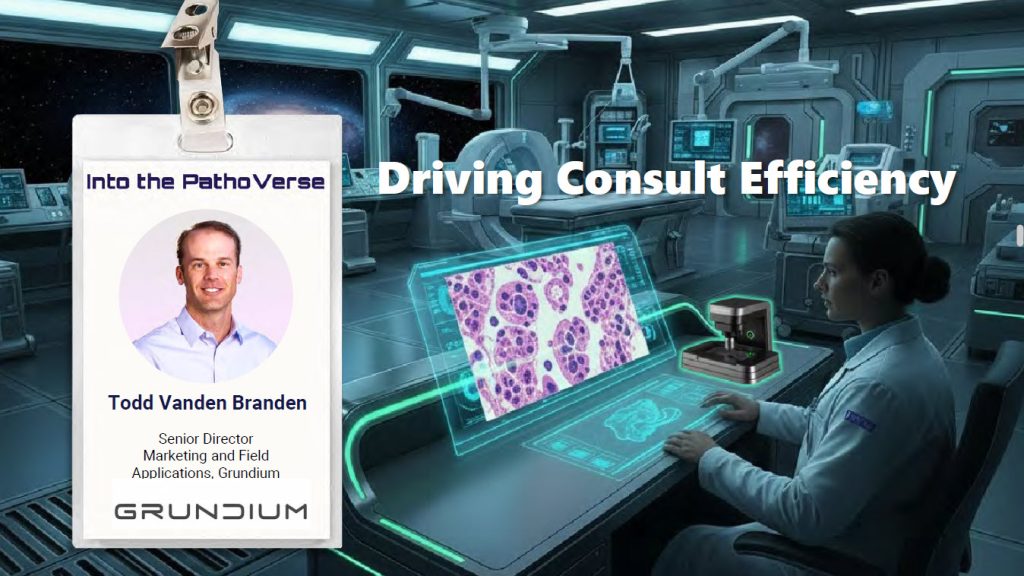
Digital pathology may feel like a futuristic vision, but in many ways the future is already here. What’s missing is widespread adoption. As Todd Vanden Branden, Senior Director of Marketing and Field Applications for Grundium, explained in this segment of our “Into the Pathoverse” webinar, the first obstacle to digital pathology isn’t complex AI or advanced analytics—it’s often something far more fundamental: the scan. Until a lab can afford to reliably digitize slides, the rest of the digital ecosystem simply can’t take shape.
And yet, many labs still struggle to take that first step.
The Pressure Cooker Facing Pathology
Anyone working in pathology is all too familiar with the pressures Todd described. Case volumes continue to rise, while the pipeline of new pathologists shrinks. In a recent presentation, Dr. Parwani from Ohio State noted that more than 700 pathology positions are currently open in the U.S.—and that number isn’t improving. Subspecialty gaps in fields like cytopathology, hematopathology, GI, dermpath, and neuropathology widen each year.
At the same time, slides don’t always sit where the expertise resides. A specimen may be hundreds of miles away from the subspecialist best equipped to interpret it. Combined, these issues create what Todd called a “perfect storm.”
Digital pathology and AI have the potential to ease that storm—but only after labs begin scanning. Today, depending on who you ask, only 15–30% of U.S. labs have adopted digital workflows. The majority haven’t even started.
So why is that?
What’s Holding Labs Back
Todd outlined four major barriers:
1. Financial constraints.
Traditional scanners come with big price tags, ongoing subscription fees, licensing costs, and consumables. For many labs—especially smaller ones—the return on investment feels too distant.
2. Space limitations.
Few labs have extra room to spare, and slide scanners are often known for their bulky footprints.
3. IT complexity.
Integration with LIS and EMR systems, plus growing cybersecurity requirements, can intimidate even well-resourced IT teams.
4. Workflow disruption.
Pathology isn’t a field that embraces change lightly. New tools can introduce learning curves, slowing day-to-day operations before they improve them.
These challenges create hesitation—not because labs don’t value digital pathology, but because adopting it feels overwhelming.
What Labs Need for Digital Adoption
Todd made an important point: to accelerate digital adoption, scanners themselves must evolve to meet the real needs of labs. Here’s what he argues scanners must offer:
- Reasonable capital costs with no hidden subscription or licensing fees, enabling faster ROI.
- A small footprint—ideally compact enough to sit where a slide folder already does.
- Simple, secure IT integration that aligns with modern cybersecurity standards.
- Easy, intuitive workflows that minimize training time and resistance to change.
Fortunately, solutions that meet these criteria already exist.
How Grundium Scanners Break Down Barriers
Grundium is one of the scanner providers redefining accessibility in digital pathology. Todd highlighted several ways their Ocus family of scanners fits the needs of modern labs:
- High-quality imaging with both single-slide and four-slide models (at 20x or 40x magnification).
- A small, portable footprint, allowing scanners to sit directly on a bench without reconfiguring the lab.
- A web-based, intuitive user interface, reducing workflow friction.
- No subscriptions, licensing fees, or consumable costs.
- Strong connectivity, enabling quick image transfer and secure remote collaboration.
- Smooth IT deployment, made to operate comfortably within existing infrastructure.
Because of this, Grundium scanners aren’t just for labs stepping into digital pathology for the first time. They’re equally useful for digitally mature centers seeking flexible point-of-care or remote-consult capabilities. Todd likes to think of them as “and” technology rather than “or” technology—a complement to larger enterprise systems, not a replacement.
A Real-World Example: OSU Wexner Cancer Center
One compelling case study comes from the Ohio State University Wexner Cancer Center, a recognized leader in digital pathology. As part of its Community Pathology Program, OSU uses Grundium’s Ocus M40 scanner alongside PathPresenter to streamline consult workflows across partner hospitals.
Traditionally, obtaining a second opinion for complex cases can be slow and risky. Physical slides must be transported, which introduces delays, fragmentation, and potential for loss or damage—none of which serve the patient who urgently needs a diagnosis. With the Ocus M40 and PathPresenter, the workflow becomes almost seamless:
- A slide is scanned locally.
- The image is sent directly through the scanner interface to PathPresenter.
- A remote subspecialist reviews it and assists in diagnosis.
At Worcester Community Hospital, a partner site, this digital consult workflow improved turnaround time by 97.8%. What once took an average of 23 hours now takes about 30 minutes. That kind of impact isn’t just operational, it’s clinical.
Never Forget What’s at the Center: The Patient and the Pathologist
Todd closed his segment with two reflections from practicing pathologists that underline why this work matters.
Dr. Parwani emphasized that when digital consult workflows are implemented well, they don’t just speed up diagnoses—they strengthen ROI for departments.
Dr. Schumacher from Worcester Community Hospital added a deeply human perspective: digital pathology elevates diagnostic quality, supports continuous learning, and makes the work itself more engaging. As she put it, it “makes the job a lot more fun and interesting.”
And that’s an important reminder. Yes, digital pathology involves impressive technology and groundbreaking AI. But at the end of the day, it’s about two things: improving patient care and supporting the people who deliver it.
The First Step Is Often the Most Important
Digital pathology has the power to expand access to specialists, strengthen smaller hospitals, and connect clinicians across geographies. But before any of that can happen, labs must take the first step—adopting scanning. By lowering barriers related to cost, space, IT, and workflow, scanners like the Grundium Ocus series make that step not just possible, but practical.
As the Pathoverse continues to grow, this foundational shift toward accessible scanning will be one of the key drivers of digital transformation—and ultimately, better care for patients everywhere.
Dive farther Into the Pathoverse:
Part 1: Introducing the Pathoverse and How We Got Here – Dr. Raj Singh, PathPresenter
Part 2: Seeking Seamless Remote Consultations – Dr. Raj Singh, PathPresenter
Part 3: Lowering Barriers and Driving Consult Efficiency – Todd Vanden Branden, Grundium
Part 4: Cloud Infrastructure for Scalable Digital Pathology – Sasha Paegle, AWS
Part 5: Accelerating Clinical Trial Enrollment – Travis Wold, Imagenomix
Part 6: Virtual Restaining for Scalable, High-Accuracy Pathology AI – Dr. Saad Nadeem, DeepLIIF/Memorial Sloan Kettering
Part 7: Conclusions: This is Just the Beginning – Dr. Raj Singh, PathPresenter
More Information
Interested in learning more about how these solutions can help solve your own challenges? Contact us.