Pathoverse Part 5: Accelerating Clinical Trial Enrollment
This article summarizes part 5 of our “Into the Pathoverse” webinar, recorded at Pathology Visions 2025 in San Diego and available on-demand. This segment starts at 37:02 in the full video. Watch the full video.
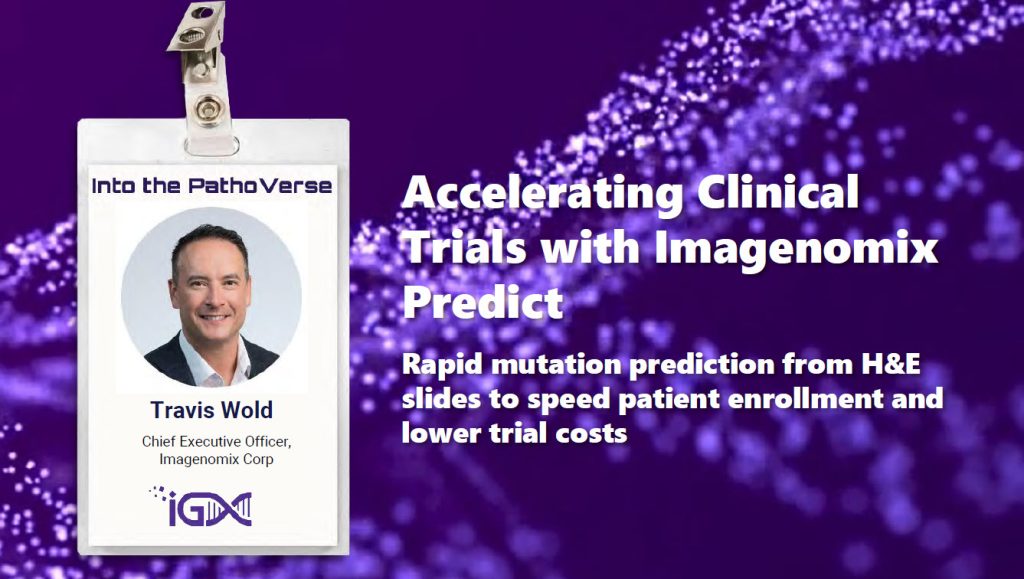
In the fifth segment of the Pathoverse webinar, Travis Wold, CEO of Imagenomix, shared a candid and energetic look at how his team is tackling one of oncology’s most stubborn challenges: clinical trial enrollment. With humor, personal anecdotes, and a clear mission rooted in his upbringing in Alaska, Wold explained how Imagenomix Predict is reshaping patient identification and trial matching—particularly for rare mutations that traditional workflows struggle to detect efficiently.
Imagenomix, a spinoff from NYU, was founded with a bold purpose: democratize precision diagnostics around the world. For Wold, this mission is personal. Growing up in a region with limited access to specialized healthcare, he understands firsthand the gaps that leave patients without the testing or treatment options widely available elsewhere. Today, his company is building the tools to bridge those gaps, beginning with clinical trials.
The Clinical Trial Enrollment Problem
Wold opened by highlighting a painful statistic: 40% of oncology clinical trials fail due to under-enrollment. The barriers are well known across the industry:
- NGS testing is slow and expensive
- Many patients never receive sequencing at all
- Delays in molecular testing mean delays in screening, enrolling, and ultimately treating patients
- Slow enrollment directly impacts regulatory timelines and revenue for pharma companies
- Academic centers often want to support trials but lack efficient tools to identify eligible patients quickly
The result is a mismatch between clinical trial goals and real-world diagnostic workflows. “It’s not that people don’t want to participate,” Wold emphasized. “It’s that we’re starting the identification process too late.”
Enhancing—Not Replacing—NGS
One misconception Wold frequently encounters is the idea that Imagenomix is trying to replace next-generation sequencing. “We’re not,” he clarified. “We’re making it more efficient.”
The company’s platform, Imagenomix Predict, uses slide-based analysis to rapidly screen for specific mutations—identifying likely positives before a patient ever undergoes sequencing. Consider lung cancer: only about 25% of U.S. lung cancers are molecularly tested. Globally, the number drops to 2% or less due to cost and access constraints.
With breast cancer, Wold illustrated a real challenge: AKT mutations occur in only about 5% of cases. If only a quarter of patients receive sequencing, the subset with rare actionable mutations becomes even harder to find. Many trials struggle to identify eligible patients within reasonable timelines.
Imagenomix flips that model. Instead of enrolling patients first, paying for sequencing, and discovering months later that they do not qualify, Imagenomix Predict screens slide images upfront for markers associated with the mutation. “We proved the biology before the trial even began,” Wold said. “Now we’re helping centers find these patients instead of hoping they appear.”
Speeding the Diagnostic Pathway
Wold contrasted the traditional timeline of NGS workflows with Imagenomix’s accelerated approach. At NYU, internal data showed that from biopsy to final NGS result, the process takes 33 to 42 days on average—even within a unified health system.
Imagenomix Predict compresses early steps dramatically:
- Day 0–1: Slides are scanned, often using a Grundium unit paired with PathPresenter.
- Within 30 minutes: Imagenomix Predict generates an initial probability report for the target mutation.
- Confirmation testing follows (PCR, ddPCR, or small panel NGS), maintaining clinical standards while reducing wasted sequencing.
This hybrid model—AI-driven triage plus gold-standard confirmation—enriches trial cohorts and accelerates time to enrollment.
Scaling Across 45 Clinical Trial Centers
As Imagenomix prepared to expand into 45 clinical trial sites with its first pharma partner, the team faced a challenge: each center had different scanners, LIS systems, and IT approvals. Some institutions did not allow software downloads; others required lengthy validation processes. The pharma sponsor also needed consistent reporting across all sites.
This is where PathPresenter became essential.
Wold explained that PathPresenter already had a footprint across many of the target institutions. Its vendor-agnostic design and no-download deployment model offered an immediate advantage. “Simplicity was everything,” he said. “PathPresenter made the whole system plug-and-play across dozens of sites.”
Combined with AWS—whose cloud services support the underlying compute and data exchange—Imagenomix was able to roll out Imagenomix Predict to 45 centers faster than expected. Wold thanked AWS for its grant support and sponsorship in helping launch the initiative.
Real-World Results: Early Mutations Identified
Despite being only a month into the first trial deployment, Imagenomix has already seen meaningful results. Wold shared that the platform has successfully identified AKT mutations early, enabling rapid confirmatory testing and immediate enrollment.
The output report, which includes probability scoring and supporting features, serves as a triage tool rather than a replacement for confirmatory assays. “Do no harm,” Wold emphasized. “We are not here to bypass gold-standard methods. We’re here to make sure those tests are being used efficiently—and on the right patients.”
Looking Ahead: Beyond Mutation Detection
While Imagenomix currently focuses on lung and breast cancer, Wold revealed that the company is developing a proprietary pipeline targeting recurrence rather than mutation status. These new products are expected to launch publicly next year and could expand Imagenomix’s reach far beyond trial enrichment.
Their long-term mission remains unchanged: make precision diagnostics accessible globally, not just in large, well-resourced academic centers.
A Glimpse of Digital Pathology’s Collaborative Future
Wold closed by sharing his excitement about the digital pathology ecosystem represented at the event. The field is full of specialized companies, each solving different parts of the puzzle. The next five years, he predicted, will bring dramatic collaboration and consolidation as these companies begin working together across workflows, tools, and data infrastructures.
In many ways, Imagenomix Predict—and its integration with PathPresenter and AWS—is an early example of that future: a connected, interoperable ecosystem designed to accelerate diagnosis, improve trial enrollment, and ultimately deliver better options to patients who need them.
Wold encouraged attendees to reach out during the event and continue the conversation about what digital pathology, AI, and cloud infrastructure can achieve when brought together under one vision.
Dive farther Into the Pathoverse:
Part 1: Introducing the Pathoverse and How We Got Here – Dr. Raj Singh, PathPresenter
Part 2: Seeking Seamless Remote Consultations – Dr. Raj Singh, PathPresenter
Part 3: Lowering Barriers and Driving Consult Efficiency – Todd Vanden Branden, Grundium
Part 4: Cloud Infrastructure for Scalable Digital Pathology – Sasha Paegle, AWS
Part 5: Accelerating Clinical Trial Enrollment – Travis Wold, Imagenomix
Part 6: Virtual Restaining for Scalable, High-Accuracy Pathology AI – Dr. Saad Nadeem, DeepLIIF/Memorial Sloan Kettering
Part 7: Conclusions: This is Just the Beginning – Dr. Raj Singh, PathPresenter
More Information
Interested in learning more about how these solutions can help solve your own challenges? Contact us.