Pathoverse Part 6: DeepLIIF Virtual Restaining for Scalable, High-Accuracy Pathology AI
This article summarizes part 6 of our “Into the Pathoverse” webinar, recorded at Pathology Visions 2025 in San Diego and available on-demand. This segment starts at 43:00 in the full video. Watch the full video.
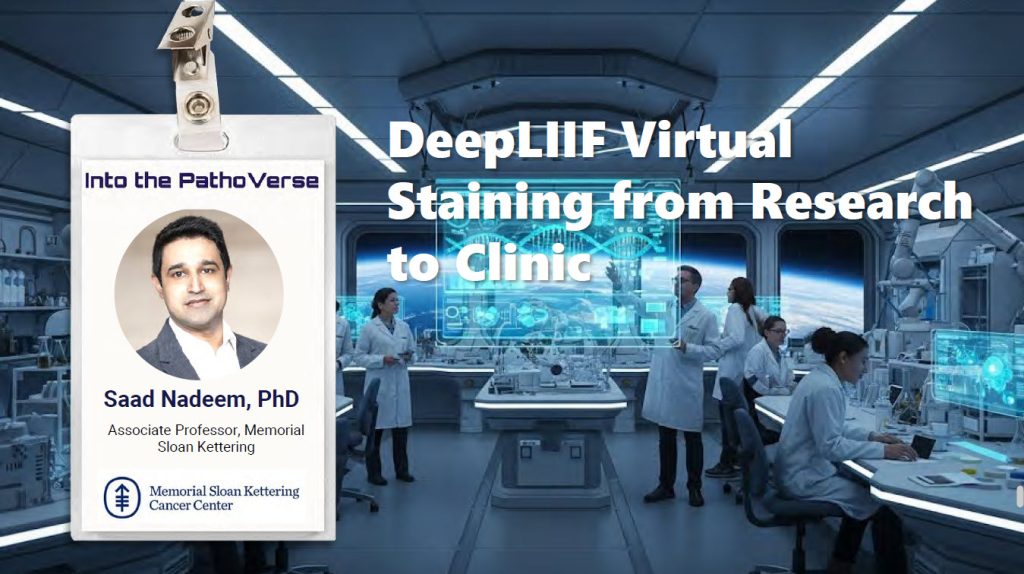
In one of the most technically exciting segments of the Pathoverse webinar, Dr. Saad Nadeem of Memorial Sloan Kettering Cancer Center (MSK) described how a research project called DeepLIIF has evolved into one of the first AI platforms deployed clinically across both pathology and surgery within a research lab. DeepLIIF, a virtual (re)staining and quantification framework, is poised to transform biomarker interpretation by improving consistency, segmentation accuracy, and dynamic range across a broad set of diagnostic markers.
Dr. Nadeem’s team has spent four years building and validating DeepLIIF, driven by a fundamental problem in pathology: extreme inter-observer variability for certain cell types and biomarkers. When macrophage interpretation can vary by as much as 80% between experienced pathologists, traditional annotation and any AI model trained on those annotations faces major limitations. DeepLIIF was designed to overcome that barrier by anchoring its predictions in perfectly co-registered biology.
A New Approach to Virtual Staining
DeepLIIF relies on a unique dataset architecture. On a single tissue section, Dr. Nadeem’s group performs multiplex immunofluorescence (mIF) staining, generating high-resolution ground truth for markers such as magenta for tumor cells, green for macrophages, and red for lymphocytes.
The same tissue is then re-stained with IHC and H&E. Because these images are perfectly co-registered down to the subcellular level, DeepLIIF’s machine learning models learn direct pixel-to-pixel transformations. The result: the ability to take a standard H&E or IHC image and virtually convert it into multiple fluorescent channels and segmentation outputs.
A key advantage lies in the dynamic range of mIF. Traditional DAB-based brightfield IHC has limited range, complicating interpretation for biomarkers like HER2-low or HER2-ultralow. DeepLIIF synthesizes high-dynamic-range equivalents, enabling more sensitive classification.
This work formed the basis of a major publication in Nature Machine Intelligence, where the algorithm demonstrated strong generalizability across markers, modalities, and tissue types.
From Open Source to Clinical Deployment
DeepLIIF launched publicly in January 2022 as a free, open-source tool at DeepLIIF.org, and its adoption has been swift. Today the platform has:
- 23,000 GitHub downloads
- 3,500 daily user sessions, a scale that rivals or surpasses many commercial vendors
- Support for 30+ markers across hematopathology, surgical pathology, and cytopathology
- Global usage, with ~30% of slides submitted from outside MSK
DeepLIIF remains MSK-patented but they have made it openly accessible, ensuring both scientific transparency and protected clinical rigor. Behind the scenes, the team continues rigorous validations across markers and cancer types. DeepLIIF’s clinical potential is rapidly expanding, with HER2 and PD-L1 support expected within weeks, followed by additional high-impact biomarkers.
DeepLIIF Integrated Into PathPresenter and CAP AI Studio
A pivotal milestone came when DeepLIIF integrated directly into PathPresenter, MSK’s primary image management system and a core pillar of the Pathoverse ecosystem. This integration enables slide ingestion, visualization, AI inference, and reporting in a unified workflow—critical for clinical translation.
Another major advancement is DeepLIIF’s availability in the CAP AI Studio, a platform launched by the College of American Pathologists and powered by PathPresenter. Through the CAP AI Studio, users can test drive a variety of AI models from multiple leading vendors with no cost and no risk. In the case of DeepLIIF, the CAP AI Studio lets CAP members try out 20+ stains on preloaded images, lasso regions of interest (ROIs), and receive quantifications in milliseconds.
Dr. Nadeem emphasized that even datasets as large as 5 million slides can be processed in real time using the system’s optimized AI–human collaboration model. This sets the stage for large-scale biomarker analysis across institutions.
Path to FDA Adoption
DeepLIIF’s clinical implementation has already begun. Working with Dr. Matt Hanna and MSK’s pathology leadership, the team secured New York State Laboratory Developed Test (LDT) approval for KI67/ER/PR in breast cancer. Next steps include FDA single-site submissions for multiple markers, supported by PathPresenter’s enterprise-grade workflows.
The projected clinical workload is significant:
- 80,000+ slides annually today
- 120,000+ slides per year once HER2 and PD-L1 modules launch
AWS plays an important role here as well. Dr. Nadeem noted that the DeepLIIF deployment on AWS is now “as cost-efficient as any commercial vendor,” enabling high-throughput inference at sustainable scale.
Expanding the Marker Ecosystem
DeepLIIF continues to grow its marker library, including PANCK, additional tumor markers, lymphocyte markers, and macrophage markers. These expansions will enable important scoring systems such as CPS (combined positive score), supporting companion diagnostics and immunotherapy workflows. The long-term vision includes converting routine IHC into virtual multiplex immunofluorescence—unlocking insights that typically require costly, specialized platforms.
DP4ALL: Digital Pathology for All
One of the most innovative parts of Dr. Nadeem’s presentation was the introduction of DP4ALL, the “Digital Pathology for All” initiative. This program responds to a frequent request from colleagues in low-resource settings: How can we digitize slides without a scanner? DP4ALL provides exactly that. Using only a basic microscope, a low-cost smartphone adapter, and a navigation-style microscope video.
Users anywhere in the world can upload short videos to the DeepLIIF platform. The system automatically:
- Stitches video frames into a whole-slide image
- Supports 10x, 20x, and 40x magnification
- Allows region-of-interest selection
- Generates shareable URLs that can be sent instantly via messaging apps
The tool is stain-agnostic, supporting H&E, IHC, and special stains. It has already been validated on more than 1,000 whole-slide reconstructions.
MSK generously supports the program, allowing the team to process 20,000–30,000 slides per year, free of charge. While this tool will never replace high volume commercial scanners in dedicated labs, it does dramatically reduce the barriers to entry into digital pathology, allowing almost any pathologist or institution to start their journey, get their toes wet and begin to prove the value of digital pathology to themselves and others.
A Global Vision for Accessible AI Pathology
Dr. Nadeem closed by encouraging attendees to explore the platform and provide feedback. His team’s work, spanning open-source tools, clinical deployment, advanced imaging science, and global access initiatives, exemplifies the Pathoverse’s core mission: connecting research, clinical workflows, and technology to improve pathology everywhere.
DeepLIIF’s journey from NYU concept to MSK clinical engine demonstrates how the right combination of AI, cloud infrastructure, and interoperable platforms like PathPresenter can bring next-generation diagnostics into everyday practice at global scale.
Dive farther Into the Pathoverse:
Part 1: Introducing the Pathoverse and How We Got Here – Dr. Raj Singh, PathPresenter
Part 2: Seeking Seamless Remote Consultations – Dr. Raj Singh, PathPresenter
Part 3: Lowering Barriers and Driving Consult Efficiency – Todd Vanden Branden, Grundium
Part 4: Cloud Infrastructure for Scalable Digital Pathology – Sasha Paegle, AWS
Part 5: Accelerating Clinical Trial Enrollment – Travis Wold, Imagenomix
Part 6: Virtual Restaining for Scalable, High-Accuracy Pathology AI – Dr. Saad Nadeem, DeepLIIF/Memorial Sloan Kettering
Part 7: Conclusions: This is Just the Beginning – Dr. Raj Singh, PathPresenter
More Information
Interested in learning more about how these solutions can help solve your own challenges? Contact us.