
PathPresenter co-Founder Dr. Rajendra Singh named to The Pathologist’s Power List 2026
Thursday October 1, 2026
Award is his sixth time on the list
All of us at PathPresenter are delighted to once again congratulate our co-founder Dr. Rajendra Singh for being honored by The Pathologist magazine in their annual Power List. This is his sixth time being on the list. Congratulations Dr. Singh!
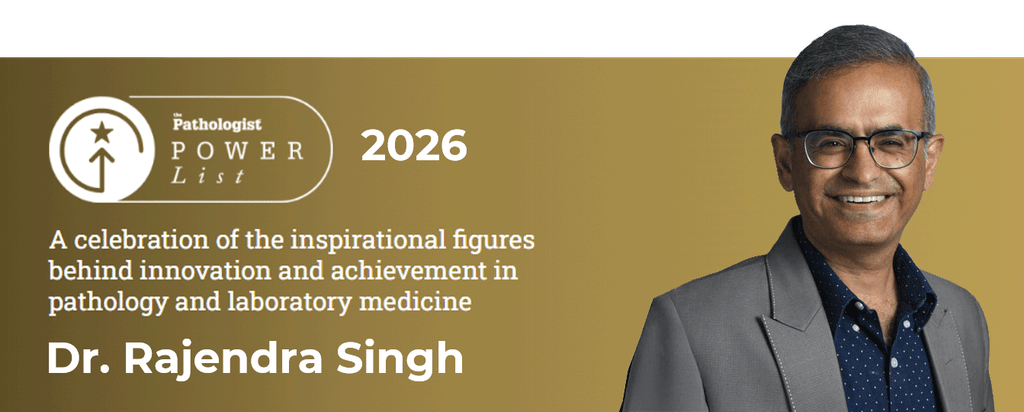
In compiling this year’s list, The Pathologist asked the pathology community what they were doing to tackle the big issues facing the lab, such as the most concerning gaps in technology/training/processes, and how to address them via innovation. Dr. Singh’s answer is below.
.
In his own words: invisible intelligence, visible responsibility
See Dr. Singh’s article on The Pathologist.
“The gap that concerns me most is not a shortage of technology. It is the distance between what AI can already do and what a pathologist’s day actually feels like.
Recently, I signed out an ordinary melanoma. By the time the report left my hands, AI had touched that case 11 times: checking slide quality, retrieving prior history, assembling and triaging the case, ranking regions for attention, helping measure depth, drafting the synoptic and coding, performing a final release check, and quietly making the case computable for research.
That is the point: the best AI in pathology should be invisible. It should remove friction, give pathologists time back, and let us spend that time on judgement rather than clerical work.
Most tools are not built this way. They are validated on curated datasets, demonstrated on a stage, then dropped into laboratories where they add clicks, ignore the LIS and never touch the daily worklist. Meanwhile, much clinical AI still lacks straightforward reimbursement and national validation pathways, leaving good science sitting on a shelf. My response has been to start where those barriers are lower: efficiency tools that can be internally validated and deliver value today while regulatory pathways mature. Here, innovation is often blocked by process, not science.
But invisibility carries a danger: invisible can also mean unaudited. If AI touched that melanoma 11 times and nobody can see where, who is accountable when it is wrong?
That is why my guiding principle is invisible intelligence, visible responsibility. Pathologists must understand, evaluate, and govern systems they may not directly see working. The pathologist remains answerable for every inference, whether they watched it happen or not.
This is also pathology’s extraordinary opportunity. Our data reaches beyond diagnosis into molecular prediction, treatment response, companion diagnostics, and drug discovery. Done properly, AI does not diminish our role; it expands it. The report can carry not only a diagnosis, but the inferences that follow from it. Pathology can become the operating system of precision medicine.
That conviction is why, as a practising pathologist, I built PathPresenter around gaps I experienced myself: agentic, invisible tools embedded in real workflows alongside a free education layer.
Will AI take part of our job? Yes, and that may be the best news in our field. What remains becomes harder, more human and more consequential.
My challenge to pathologists is simple: understand these tools, govern them, and claim the report before someone else does.”
PathPresenter extends our sincere congratulations to all the honorees. The field and the world are fortunate to have so many inspiring, accomplished individuals. View the entire list on The Pathologist’s website.
More posts
- PathVisions2026 Workshop: How Leading Centers Are Building Connected Pathology Workflows with PathPresenter
- PathPresenter co-Founder Dr. Rajendra Singh named to The Pathologist’s Power List 2026
- Primaa and PathPresenter Introduce Fully-Integrated AI Workflows for Dermatopathology
- The Proof Problem, Part 1: AI Isn’t Replacing Our Job. It’s Adding a New One.
- The Business of Pathology: Unlocking a Lab’s Value