The Business of Pathology: Unlocking a Lab’s Value
Monday July 27, 2026
INDUSTRY INSIGHT from Signify Research

Guest Authors:
Alan Stoddart, Editor, Healthcare Technology
Imogen Fitt, Principal Analyst, Digital Laboratory and Lifesciences
Digital pathology is a discipline of promise.
Providers are promised that the adoption of digital pathology will make them more efficient, enable their pathologists to add greater value and take advantage of sophisticated solutions. These opportunities are real and within reach, but so far only a limited number of sites have been able to realise them.
In many cases, the barriers have been difficult to overcome. The cost of transitioning to digital pathology can be prohibitive, particularly if the return on that investment is hard to quantify. In addition, supporting pathologists, whose priority is their patients, through the change can be challenging for providers. The move can also give headaches to department heads and financial stakeholders, who must cost-effectively navigate issues of interoperability, deploying tools that facilitate flexibility long-term, not simply a solution that works today.
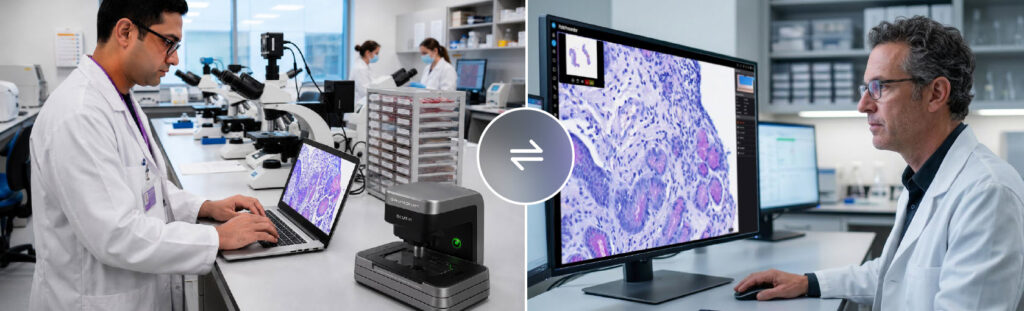
One answer is remote consultation solutions, which offer labs a way to affordably and profitably take advantage of digital pathology, while lightweight implementations minimise adoption challenges.
The Growing Need for Specialty Expertise
Such answers are very timely.
The cases pathology labs are being tasked with are more complex than ever, with growing use of precision medicine leading to more sophisticated testing, while multidisciplinary approaches are driving up the intricacy of a pathologist’s work.
This complexity often benefits from highly specialised expertise, but such expertise is a scarce resource and unequally distributed. However, by using remote consultation solutions, granting labs instant access to a wealth of specialist pathologists from across the world, the impacts of this shortage can be mitigated.
This could be crucial. Without swift, accurate analysis, diagnosis is delayed, which in turn delays treatment planning and delivery. Delayed or incorrect diagnoses stemming from a lack of expertise not only limit patients’ access to the best possible outcomes, they can be expensive for hospitals. Providers may need to deliver interventions which might otherwise have been avoided or provide costly additional treatments. More starkly, providers are also open to expensive litigation, highlighting the financial risk that a shortage of expertise raises.
Consultation Solutions: The Network Effect
The complexity of conditions, along with the vast range of possible treatments constantly being introduced, means that subspecialty expertise is often required if patients are to benefit from the most personalised care; however, this level of specialisation is often beyond the scope of a single provider.
Remote consultation solutions, such as those enabled by PathPresenter, solve this problem. The company’s tools facilitate secure telepathology for both primary and secondary reads. As such, providers can leverage pathologist capacity outside their own networks, ameliorating constraints and opening access to a large number of specialists regardless of geography.
Labs already using the PathPresenter IMS have remote consultation capability directly available and can leverage PathPresenter’s integration with their existing LIS for workflow.
For those labs yet to fully adopt digital pathology, or for those on IMS systems that lack remote external consultation functionality, there is a zero-footprint version. This fully web-based alternative can be deployed in days without significant investment, LIS integration, or demanding infrastructure requirements. Pathologists can access the solution directly in their browsers via secure web portals, enabling them to receive, view and sign off second opinion cases from referring hospitals across the world.
This lightweight version, in particular, offers laboratories a low-friction route to take their first steps in a digital transformation. With minimal investment, labs can begin to prove the use case of digital pathology on their own patients and build evidence that demonstrates a return on investment, allowing providers to make better-informed decisions as they ramp up their rollout of digital pathology.
In doing so, providers can leverage the advantages that digital consultation workflows support. Pathologists are better able to devote themselves to the parts of their work which add the most value, with resource limitations and the pressures they create mitigated. They are also better able to leverage their specialist expertise, providing valuable second opinions on complex cases while also generating revenues for their own pathology departments. As such, remote consultations and second opinions have the potential to become a key tool in every institution’s arsenal.
The Future Pathology Department and the Pathology Feedback Loop
The availability of this capability will help transform pathology departments in the coming years.
Patients and their physicians will not be limited by the knowledge within their own institutions. Instead, advanced subspecialty expertise can be enlisted, augmenting a provider’s own in-house team to deliver more personalised care and improved outcomes. Referring institutions will easily and affordably be able to leverage this expertise, thanks to low-impact tools that make recruiting external pathologists simple.
Effectively, this also increases the utility of subspecialist expertise. By making it more accessible, its value is increased, thereby justifying greater resources devoted to this expertise. This positive feedback loop empowers pathologists’ own development, allowing them to specialise further; it is a valuable asset for providers as they meet the demands of precision medicine.
Perhaps the most transformative result will come at an enterprise level, however. Pathology is, at present, often considered a necessary expense. Its value to patient care is unquestioned, but it is a cost centre, not a profit centre, impacting the department’s influence and investment. Remote consultation can be instrumental in overcoming this, and providing second opinions for other institutions can generate hundreds of dollars a case. Given the relatively low investment required to adopt PathPresenter’s solutions and realise these revenues, offering second opinions could be a quantifiable income stream for institutions, as organisations such as The Ohio State University Comprehensive Cancer Center-Arthur G. James Cancer Hospital and Cincinnati Children’s Hospital Medical Center have found.
This value justifies increased investment in pathology departments, enabling procurement of additional hardware and software solutions, as well as investment in new technologies such as AI. In doing so, remote consultation can become a core component in the elevation of in-institution diagnostics.
Pathologists themselves also stand to benefit, with their roles evolving as a result of consult tools. For instance, PathPresenter’s browser-based platform makes it easier for pathologists to work flexibly and remotely. Instead of relying almost entirely on the slide itself, remote consult solutions also mean that diagnosticians will have much more information available to them, and advanced AI diagnostic tools can be applied more directly. This will position pathologists more centrally in multimodality diagnostic workflows, ultimately empowering them to take a lead role in the realisation of precision medicine.
Delivering Pathology ROI
Realising this vision of a profitable, efficient, pathologist-centred laboratory is in reach, but adopting these processes will require active management on the part of institutions. Expensive, admin-heavy and time-consuming consultation practices involving the preparation, protection and physical sharing of slides can be replaced by digital delivery. This makes the process cheaper, near instantaneous and with reduced risk of damaging the slide. It also enables the same sample to be assessed by several pathologists simultaneously, should varied expertise be required.
Remote consultation solutions’ role in addressing these barriers, lowering these costs and mitigating these risks also aids the transformation of pathology departments from cost centres into profit centres, which further enables their evolution. Vendors such as PathPresenter could be especially valuable in this process. The vendor’s IMS helps pathology departments already deep in their digital pathology transformation to capitalise. But those who have not yet made such a deep investment can still take advantage of the vendor’s lightweight platform. This may be a gentler route to unlocking the opportunities offered by digital pathology, enabling practical success and building value before financial commitment is needed.
Above all, the greatest promise offered by digital pathology’s adoption is in granting patients longer, healthier lives. Transitioning to the technology has usually represented an expensive shift for providers, with significant risks. But, a lightweight, flexible approach flattens these hurdles, enabling digital pathology to be utilised, without a daunting commitment.
Moreover, remote consultation solutions such as those offered by PathPresenter mitigate shortages of pathologists and allow the expertise of subspecialist pathologists to be leveraged as a central component of multidisciplinary workflows. In doing so, they help providers to truly realise digital pathology’s promise.
— — —
About the Authors
Alan Stoddart joined Signify Research in 2020. Coming from a business intelligence background, Alan now leads Signify Research’s Insight and Editorial services. His work focuses on Signify Research’s Digital Laboratory & Life Sciences Premium Insight service, where he covers digital pathology, laboratory technologies, and healthcare innovation through independent market analysis and industry insights.
Imogen Fitt is a Principal Analyst at Signify Research, leading the company’s coverage of Digital Laboratory and Lifesciences markets. Since joining in 2018, she has been instrumental in establishing Signify Research as a leading authority in digital pathology market intelligence. She holds a First-Class degree in Biomedical Sciences from the University of Warwick and brings additional expertise across Laboratory Information Systems, genomics, real-world data, and AI in drug development, supporting expanded coverage of both clinical and preclinical markets.
More Posts
- Primaa and PathPresenter Introduce Fully-Integrated AI Workflows for Dermatopathology
- The Proof Problem, Part 1: AI Isn’t Replacing Our Job. It’s Adding a New One.
- The Business of Pathology: Unlocking a Lab’s Value
- Expanding Access to Hantavirus Education: Sharing Images Through the PathPresenter Public Library
- The Future of Pathology Part 3: The Delivery Problem and the Infrastructure of Intelligence