
Pathology Education: The Digital Future Is Here
Monday February 23, 2026
The next generations of pathologists are demanding digital education now
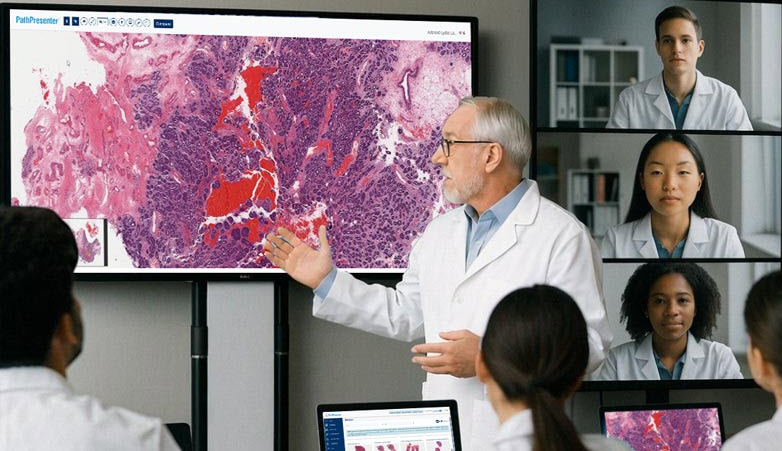
As medicine becomes more precise and data-driven, pathology is undergoing a transformative shift toward digital technology. This transition promises to revolutionize how pathologists work, improving accuracy, efficiency, and collaboration, while ultimately enhancing patient outcomes. Nowhere is this transformation happening faster or more profoundly than in pathology education. And increasingly, it is pathology trainees—residents and fellows—who are driving the demand.
A recent example from the Yale School of Medicine puts this shift into clear focus. When distinguished Yale professor and internationally recognized genitourinary pathologist Dr. Peter A. Humphrey, MD, PhD, retired in 2025, he left behind a spectacular and unique collection of pathology slides that he had used to educate generations of trainees about rare and complex cases. Over 40 years of practice, consultation, and teaching, Dr. Humphrey amassed not just slides, but insight: annotations, diagnostic pearls, and pattern-recognition wisdom refined over decades.
Through a project led by Dr. Roxanne Wadia, these slides are now being digitized (using the PathPresenter platform), along with Dr. Humphrey’s annotations, so that his experience can continue to guide new generations of residents and fellows at Yale and beyond.
“Dr. Humphrey’s slide collection represents a lifetime of mastery, an extraordinary legacy that deserves to be more than preserved,” said Dr. Raj Singh, professor of pathology and PathPresenter co-founder. “It deserves to be shared.”
This kind of knowledge sharing is admirable, but for today’s trainees, that sharing is not just inspiring, it is becoming expected and even essential. At Yale and many other institutions, digital platforms are no longer viewed as optional enhancements. They are becoming core infrastructure for training pathologists in a world that is already digital.
The Advantages of Digital for Pathology Education
When it comes to delivering pathology education, a digital platform such as PathPresenter offers compelling benefits. But viewed through the lens of trainees, these advantages become even clearer: digital tools directly address the daily challenges residents and fellows face.
Eliminating Physical Constraints
Residents learn pathology by seeing cases—lots of them. Yet traditional training models often limit access. Glass slides are tied to specific microscopes, labs, and physical locations. Rare cases may be archived and difficult to retrieve. Multi-headed scopes allow small-group teaching, but only for those physically present.
Digital platforms eliminate these constraints. With whole-slide imaging, specimens can be digitized at high resolution and shared almost instantly with learners anywhere in the world. Instead of crowding around a microscope, trainees can review cases independently, revisit them after sign-out, and study them before board exams. They can zoom, pan, and explore at their own pace, without worrying that the slide must be returned to circulation.
For busy residents balancing clinical service, conferences, research, and exam preparation, this flexibility is transformative. Learning is no longer limited to “when the slide is available.” It becomes on-demand and continuous.
Pathology depends heavily on visual pattern recognition. Even the most detailed written description of a cellular structure cannot match the power of an image. When trainees and attendings view the exact same digital slide simultaneously, discussions are more precise. Feedback is clearer. Diagnostic reasoning becomes more transparent.
Digital images also preserve rare and valuable cases that trainees might otherwise never encounter. Instead of being stored in a single institutional archive, these collections can be shared globally. For residents preparing for subspecialty fellowships or boards, exposure to rare entities is invaluable.
This is precisely what Yale envisions for Dr. Humphrey’s collection: preserving and sharing his legacy so it can continue to guide and challenge future pathologists. Open access to world-class pathology knowledge is not just a philosophical goal, it directly supports trainee growth and confidence.
Unlocking Interactive Learning
Today’s trainees do not want to passively observe, they want to interact.
Digital platforms enable educators to annotate directly on slide images, highlight key diagnostic features, add measurements, and create guided tours through complex cases. For trainees, these annotations become enduring teaching points that can be revisited long after the live session ends.
Learners can also engage actively, leaving comments, asking questions, and even participating in real-time chats. Instead of fleeting conversations at a microscope, discussions become documented and searchable. Slide metadata, clinical history, and diagnostic commentary can travel with the image, ensuring that context is never lost.
For residents preparing for tumor boards, unknown conferences, or board examinations, this depth of context is critical. It allows them to connect morphology with clinical implications, immunohistochemistry, molecular findings, and outcomes.
Digital platforms also support structured curriculum delivery. Organized modules, case libraries, integrated quizzes, and assessments provide clarity in a training environment that can otherwise feel overwhelming. Immediate feedback helps trainees identify knowledge gaps early. Progress dashboards and certification tracking bring transparency to competency development.
In an era where pathology training varies across institutions, digital platforms help standardize access to high-quality content. For trainees, that consistency means greater confidence, regardless of where they train.
Enabling Global and Remote Learning
Trainees today are part of a global medical community, and digital pathology platforms break down geographic barriers, allowing residents and fellows to learn from experts far beyond their home institutions. A trainee in a resource-limited setting can now access the same high-quality cases and instruction as a learner at a major academic center.
Virtual tumor boards, international conferences, and cross-border case discussions are no longer rare events, they are increasingly routine. For fellows pursuing subspecialty expertise, exposure to diverse case material and global perspectives strengthens both diagnostic skill and professional networks.
For many trainees, remote learning is not a compromise; it is an opportunity, and perhaps even a necessity.
Integrating Artificial Intelligence into Training
The pathologists of tomorrow will practice in environments shaped by artificial intelligence. AI models are already being integrated into clinical workflows and research applications, from image analysis to diagnostic support.
Trainees recognize this shift. They want to understand not only how to interpret slides, but how to evaluate and leverage AI tools responsibly.
Comprehensive digital platforms provide a natural environment for this integration. In a digital workspace, residents can explore AI-assisted analyses, compare algorithmic outputs with their own interpretations, and develop the critical thinking skills necessary to use these tools wisely.
Exposure during training ensures that future pathologists are fluent in both traditional morphology and digital augmentation. Digital literacy is becoming as fundamental as microscopic technique.
Meeting Trainee Expectations
Today’s residents and fellows are digital natives. They expect intuitive interfaces, instant access to resources, and collaborative tools that resemble the platforms they use in other aspects of their lives.
They also understand that their future employers (academic centers, hospitals, laboratories) are moving toward digital pathology workflows. They want their training environment to reflect that reality.
Institutions that embrace digital platforms signal to trainees that they are forward-looking and invested in preparing them for modern practice. Those that do not risk falling behind, not only technologically, but competitively in recruiting top talent.
The Digital Future Is Now
The shift toward digital pathology education is already underway, and trainees are at its center. The benefits are clear: expanded access, interactive learning, global collaboration, standardized curricula, AI integration, and preparation for real-world practice.
As the practice of pathology becomes increasingly digital, education must mirror that evolution. For residents and fellows, digital platforms are not optional enhancements. They are essential tools for mastering the discipline.
Let Us Help You on Your Path
PathPresenter was created specifically to unlock the opportunities that a digital education platform offers. With tens of thousands of users, our public platform is the world’s largest pathology education community. For institutions, our enterprise education module enables organizations to manage, deliver, and generate measurable ROI on digital pathology education, while integrating seamlessly with clinical practice and research.
Whether you are modernizing your residency curriculum, digitizing legacy collections, hosting global conferences, or building a private learning portal for trainees, PathPresenter has a powerful platform to help you. We would be delighted to discuss your pathology education goals.
The next generation of pathologists is ready for a digital future. Let us help you build it.
More Posts
- PathVisions2026 Workshop: How Leading Centers Are Building Connected Pathology Workflows with PathPresenter
- PathPresenter co-Founder Dr. Rajendra Singh named to The Pathologist’s Power List 2026
- Primaa and PathPresenter Introduce Fully-Integrated AI Workflows for Dermatopathology
- The Proof Problem, Part 1: AI Isn’t Replacing Our Job. It’s Adding a New One.
- The Business of Pathology: Unlocking a Lab’s Value