
The algorithm is ready. The question is whether our departments are.
Monday May 25, 2026

by Rajendra Singh MD
Professor of Pathology, University of Pennsylvania
Co-Founder, PathPresenter
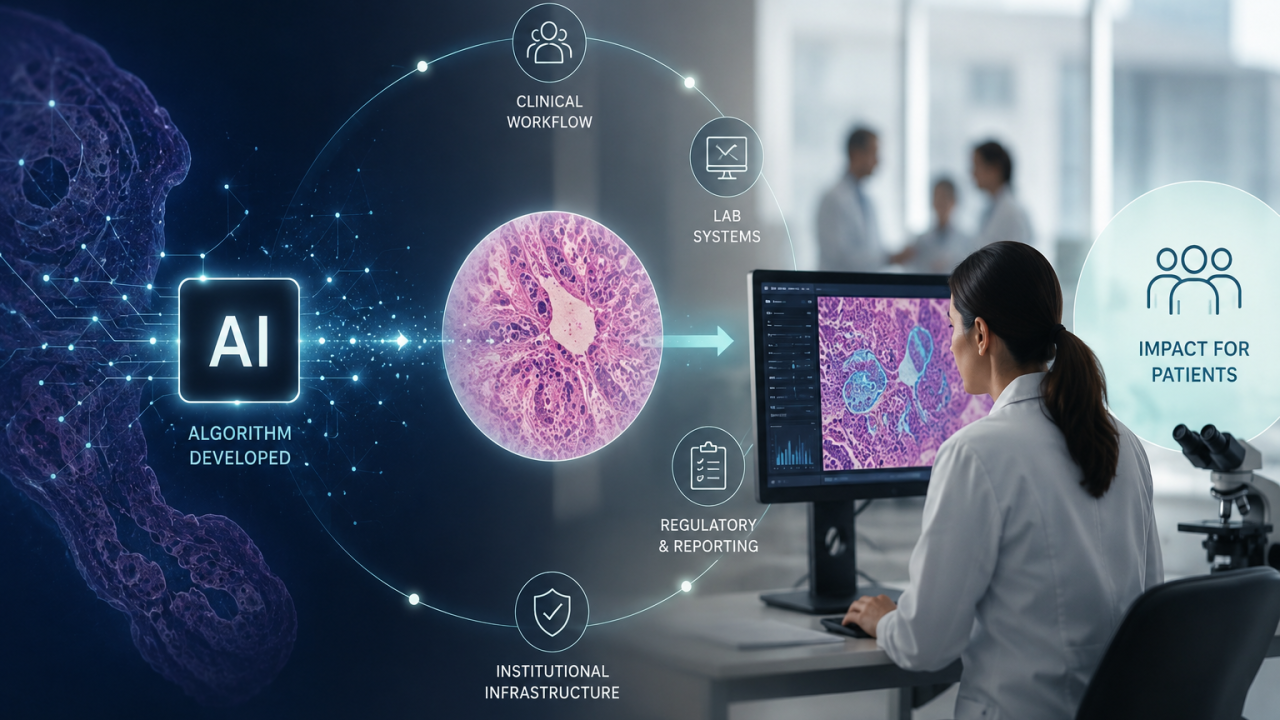
As a pathologist, this feels to me like one of the most important moments our specialty has seen in decades.
Not because AI in pathology is new. Most academic departments have been thinking about computational pathology, biomarker quantification, and digital workflows for the last few years. What feels different now is that these tools are no longer being discussed primarily as research infrastructure or future possibilities. They are beginning to shape real treatment decisions.
Roche’s acquisition of PathAI is a significant signal that computational pathology has moved into the center of precision oncology strategy. The implications are larger than a single acquisition.
For years, pathologists have understood something that the broader healthcare ecosystem is only now fully appreciating: the biopsy is not simply supporting information for oncology care. Increasingly, it is where therapeutic eligibility is determined. As AI-enabled companion diagnostics become regulatory-grade clinical tools, pathology workflows are becoming directly connected to treatment access.
The emerging generation of ADCs and biomarker-driven therapies illustrates this clearly. Many of these treatments depend on increasingly nuanced tissue-based interpretation — quantitative scoring, spatial context, low-expression biomarkers, and patterns difficult to assess reproducibly through conventional microscopy alone. The pathologist remains central to interpretation, but the infrastructure around that interpretation is changing rapidly.
The Real Challenge: Deployment Over Development
An algorithm may be developed in a research environment, but it ultimately it has to function inside a clinical department. It must integrate into the daily workflow of pathologists, connect to existing laboratory systems, support regulatory and reporting requirements, and operate within institutions that have already made long-term infrastructure decisions. That deployment challenge is likely to become one of the defining questions of computational pathology over the next several years.
The academic medical centers where many of these patients are diagnosed are extraordinarily complex environments. They are simultaneously delivering clinical care, running trials, training residents and fellows, conducting translational research, supporting tumor boards, and managing large-scale image archives. Any AI companion diagnostic that hopes to achieve broad adoption will need to fit naturally into that ecosystem.
This is why workflow and institutional trust matter as much as algorithmic performance.
Pathology departments do not adopt infrastructure lightly. The systems that succeed over time are the ones that integrate cleanly into clinical operations, support a wide range of departmental needs, and earn confidence through years of daily use. In practice, the operational realities of pathology often determine whether even highly sophisticated technologies can meaningfully reach patients.
None of this diminishes what companies like Roche and PathAI have accomplished. The field needs validated, clinically deployable AI systems, and the progress being made is genuinely exciting for pathology and oncology alike.
But the next phase of the field may be defined less by whether these algorithms can be built, and more by how effectively they can be deployed within the institutions where precision oncology is actually practiced.
About the Author
Dr. Rajendra Singh is a Professor of Pathology at the University of Pennsylvania and co-founder of PathPresenter. He serves as a member of the Digital and Computational Pathology Committee of the CAP, Editorial Board of the WHO for Classification of tumors, 5th Edition and the Board of Digital Pathology Association.
More Posts
- Primaa and PathPresenter Introduce Fully-Integrated AI Workflows for Dermatopathology
- The Proof Problem, Part 1: AI Isn’t Replacing Our Job. It’s Adding a New One.
- The Business of Pathology: Unlocking a Lab’s Value
- Expanding Access to Hantavirus Education: Sharing Images Through the PathPresenter Public Library
- The Future of Pathology Part 3: The Delivery Problem and the Infrastructure of Intelligence