
The Pathologist as the Architect of Clinical Intelligence
Monday April 13, 2026

by Rajendra Singh MD
Professor of Pathology, University of Pennsylvania
Co-Founder, PathPresenter
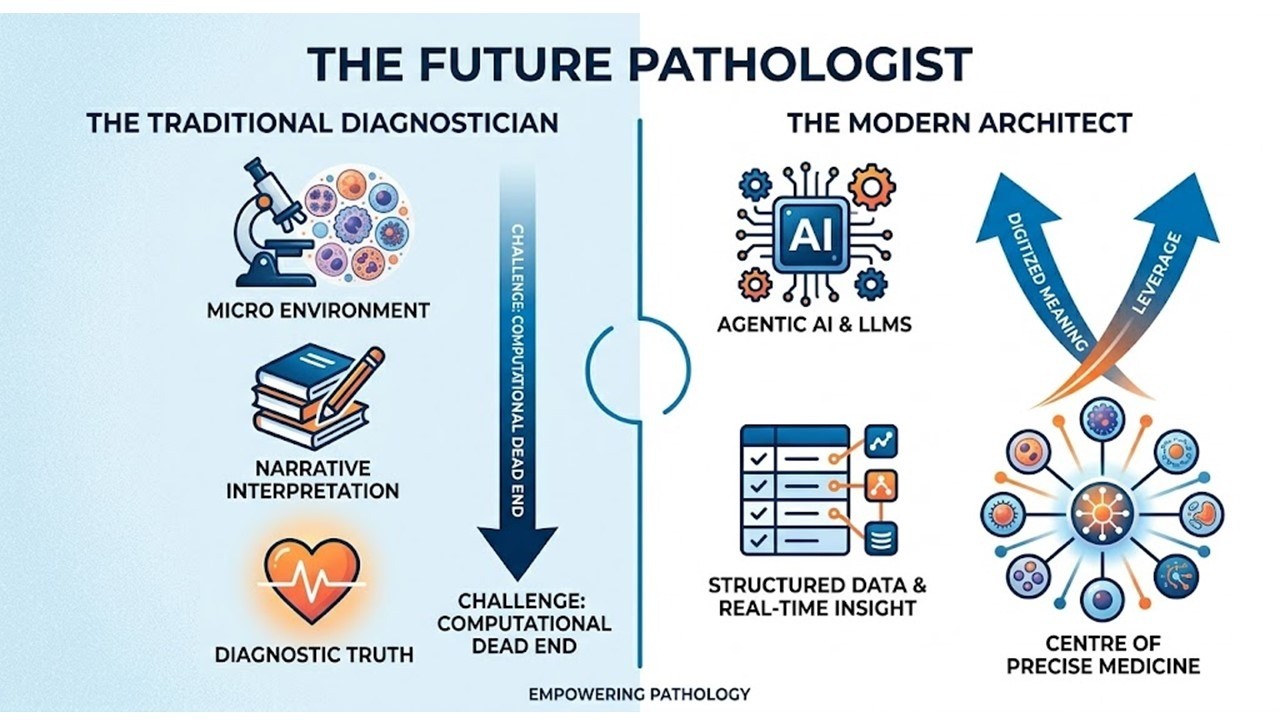
Last week, I was invited to serve as a judge for a “Shark Tank” style competition at the University of Pennsylvania. At the conclusion of several spectacular presentations, all of which featured the innovative use of AI, a resident in the audience asked the million-dollar question: “Do I have a future as a pathologist?”
It is a question often framed with uncertainty—will AI replace us or commoditize our work? My answer is that the role of the pathologist is not diminishing but quietly expanding. We are moving from a diagnostic service to becoming the most valuable data engine in medicine. For decades, pathology has been the “ground truth” where cells and microenvironments are observed directly. Yet, this richness has historically been a computational dead end because we digitized images without digitizing meaning.
That transition is occurring now through three converging technological shifts that turn the image management system into an active collaborator. First, Foundation Models now read whole-slide images directly to extract critical features like TIL density and tumor burden. Second, Structured Narrative tools utilizing large language models convert our narrative prose into governed data with accuracy exceeding manual abstraction. Finally, Agentic Frameworks allow for cohort definition in plain language, delivering traceable results in minutes and removing traditional operational bottlenecks. Together, these technologies ensure that everything visible on a slide becomes computable.
The true power of these technologies lies in their invisibility; intelligence is embedded directly into the Image Management System (IMS) rather than being siloed in a dashboard. While the pathologist focuses on the diagnosis, background agents handle the operational heavy lifting. Specimen Logistics agents follow specimens through the lab to identify delays or staining inconsistencies before they breach turnaround times. Predictive Metadata Enrichment anticipates clinical pathways by identifying likely immunostains or molecular tests, suggesting CPT codes, and pre-filling reports. By surfacing relevant literature and potentially providing “virtual stains” that eliminate 48-hour waits, the platform ensures expertise is supported by a comprehensive data layer without interrupting workflow. Even the complex ontologies and data standards that once took years of committee work to codify can now be harmonized on the fly. By utilizing supervisory agents that map local findings to global standards in the background, we ensure that a diagnosis rendered in one institution carries the same precise, computable meaning in another. This background alignment allows the pathologist to focus entirely on the tissue while the system ensures the resulting data is instantly interoperable and research-ready.
This evolution reframes our impact from “throughput” to “leverage”. Each diagnosis is no longer a discrete event; it becomes a computable data point in a multimodal dataset. Because we see the disease itself in its structural context, we are uniquely positioned to lead this transformation. The future of healthcare will be built around the data that pathologists already hold. Our opportunity is to remain operationally central by shaping how these systems are designed and how meaning is preserved. Pathology is no longer just a service; it is the most valuable data asset in medicine, and those who build this capability first will hold the keys to the future of personalized care.
The future of pathology has never been brighter; we are moving from the basement of the hospital to the very epicenter of precision medicine, where our insights will drive every major clinical decision in the digital age.
About the Author
Dr. Rajendra Singh is a Professor of Pathology at the University of Pennsylvania and co-founder of PathPresenter. He serves as a member of the Digital and Computational Pathology Committee of the CAP, Editorial Board of the WHO for Classification of tumors, 5th Edition and the Board of Digital Pathology Association.
More Posts
- Primaa and PathPresenter Introduce Fully-Integrated AI Workflows for Dermatopathology
- The Proof Problem, Part 1: AI Isn’t Replacing Our Job. It’s Adding a New One.
- The Business of Pathology: Unlocking a Lab’s Value
- Expanding Access to Hantavirus Education: Sharing Images Through the PathPresenter Public Library
- The Future of Pathology Part 3: The Delivery Problem and the Infrastructure of Intelligence