Success Story: Expanding Access to Expert Cancer Diagnostics Through Digital Pathology Consultations
Friday May 1, 2026
How The Ohio State University Comprehensive Cancer Center and PathPresenter enabled faster, more equitable second opinions across a regional network
In Brief
Access to subspecialty pathology expertise can significantly influence cancer diagnosis, treatment planning, and patient outcomes. Yet many regional and community hospitals lack the depth of specialized pathology resources available at large academic medical centers. The Ohio State University Comprehensive Cancer Center-Arthur G. James Cancer Hospital and Richard J. Solove Research Institute (OSUCCC-James) addressed this gap by launching a digital pathology second opinion consult service across its James Cancer Network.
By partnering with PathPresenter, OSUCCC-James implemented a scalable, digital-first consultation workflow that eliminates traditional barriers such as physical slide transport, redundant data entry, and incompatible systems between institutions. At the center of this solution is PathPresenter’s clinical consultation module, enhanced with OCR-driven case accessioning that automatically extracts patient and case metadata directly from slide labels.
This innovation allows partner sites like Wooster Community Hospital to seamlessly submit cases for expert review without requiring a shared laboratory information system (LIS) or additional administrative burden. Subspecialist pathologists at OSUCCC-James can review cases within hours, dramatically reducing turnaround time compared to legacy workflows that could take days or weeks.
The result is a more connected, efficient, and equitable diagnostic network: one that extends advanced cancer expertise into local communities, improves clinical decision-making, and opens new pathways to clinical trials and specialized care.
The Goal: Bringing Specialist Expertise Closer to Patients
Accurate pathology interpretation is foundational to effective cancer care. Subtle diagnostic nuances can determine treatment pathways, eligibility for targeted therapies, and access to clinical trials. While academic centers like OSUCCC-James house world-class subspecialty expertise, many smaller or regional hospitals operate with limited pathology resources.
Recognizing this disparity, OSUCCC-James included remote pathology consultations in the services it offers through The James Cancer Network, a collaborative initiative designed to extend advanced oncology services beyond its main campus. Through this network, partner institutions gain access to training, research opportunities, and, critically, expert diagnostic support.
The need for consultations was clear. However, delivering this capability at scale required overcoming several operational and technical challenges. Among OSUCCC-James’s requirements for a successful solution:
- Rapid turnaround times to support timely clinical decisions
- Minimal logistical complexity, especially eliminating physical slide transport
- Reduction of manual data entry and administrative overhead
- Flexibility to integrate with diverse systems across partner institutions
- A seamless and reliable experience for consulting pathologists
- Strong privacy, security, and regulatory compliance
- Scalability to support a growing network
Digital pathology was the obvious foundation, but implementing it effectively required more than simply digitizing slides.
The Challenge: Fragmented Systems and Inefficient Workflows
While digital pathology enables remote viewing of whole slide images (WSIs), the surrounding workflow, particularly case accessioning and data management, often remains fragmented.
In typical consultation workflows, when a regional hospital submits a case for consultation, there is plenty of work besides the actual slide scanning. Staff must create or export a case record from their local LIS, and often re-enter patient and case information into the receiving institution’s system.
This process introduces delays, increases the risk of transcription errors, and places additional strain on already limited staff resources. The problem is compounded when partner institutions use different LIS platforms or lack such systems altogether.
For OSUCCC-James, these inefficiencies posed a significant barrier to scaling their consultation program. They needed a solution that could:
- Work across heterogeneous or absent LIS environments
- Automate case creation without duplicating effort
- Maintain data integrity and compliance
- Fit naturally into existing clinical workflows
The Solution: PathPresenter’s Consultation Module with Automated Case Accessioning
To address these challenges, OSUCCC-James partnered with PathPresenter, leveraging a long-standing relationship built on educational, research, and clinical deployments of PathPresenter’s IMS.
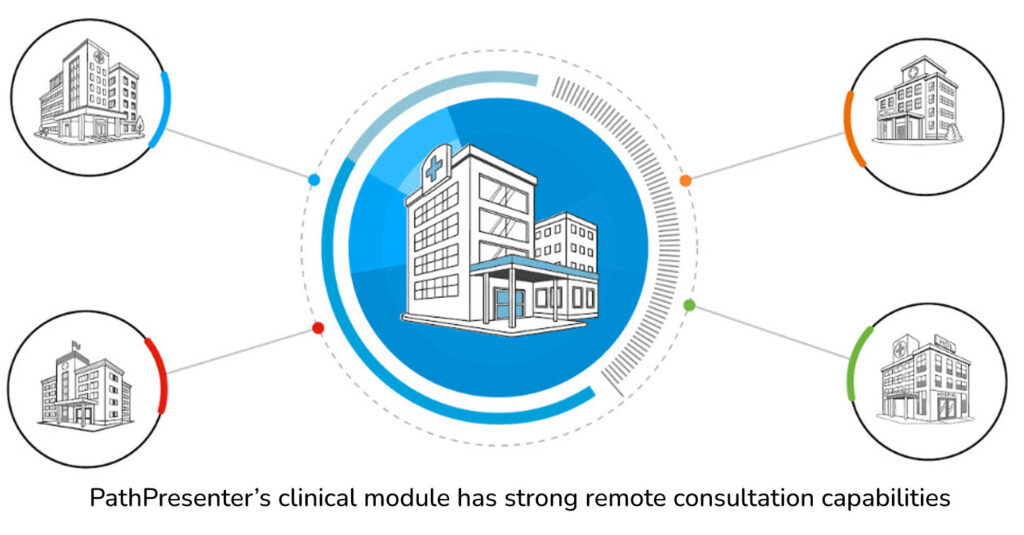
PathPresenter’s platform already offered a robust, FDA-cleared clinical viewer and class-leading consultation capabilities. For this initiative, the collaboration focused on extending these capabilities to streamline remote case submission and management.
The key innovation was an OCR-based case accessioning workflow.
In this approach, PathPresenter extracts relevant metadata, such as patient identifiers and case details, directly from the labels present on the scanned slide images. This information is automatically interpreted and structured into a digital case record, eliminating the need for manual data entry.
This automated workflow has several immediate advantages:
- No reliance on a shared LIS or complex integrations: Partner institutions do not need to use the same system as OSUCCC-James
- Reduced administrative burden: Staff are not required to manually enter patient and case details
- Improved accuracy: Automated data capture reduces transcription errors
- Faster case submission: Cases can be created and transmitted in minutes
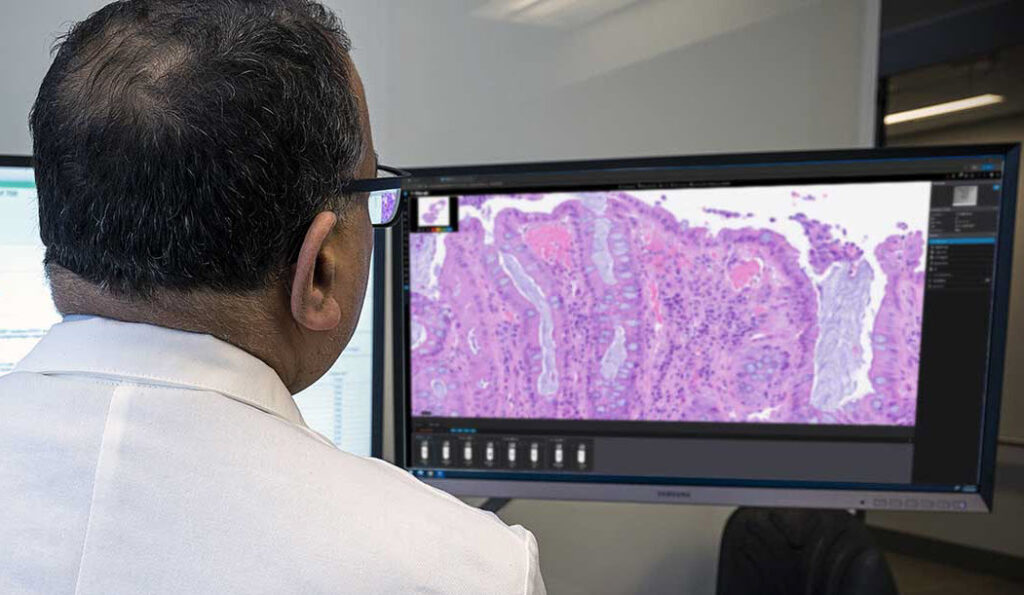
Once a case is submitted, the digital case is automatically ingested into OSUCCC-James’ central EPIC LIS and assigned to the requested subspecialist pathologist or an appropriate subspecialist based on case requirements. The pathologist reviews the case using PathPresenter’s IMS and FDA-cleared viewer, and signs out the diagnosis, with the report automatically transmitted back to the LIS and the referring hospital, closing the loop.
This end-to-end workflow transforms what was once a multi-day or multi-week process into one that can be completed within hours.
With this program’s implementation, announced by OSUCCC in April, remote centers like Wooster Community Hospital can now submit cases without needing an LIS at all, relying instead on the automated workflow built into the platform to handle the flow without increasing the administrative burden.
Results and Impact: Faster Diagnoses, Broader Access, Better Care
The implementation of PathPresenter’s digital consultation workflow brings measurable impact across the James Cancer Network.
Dramatically Reduced Turnaround Times
Consultation timelines can reduce from days or weeks to just hours. This acceleration enables faster clinical decision-making, which is especially critical in oncology where timely intervention can significantly affect outcomes.
Elimination of Physical Logistics
The need to transport glass slides has been effectively removed. This not only reduces delays but also minimizes the risk of damage or loss during transit.
Streamlined Workflows and Reduced Administrative Burden
Automated case accessioning eliminates redundant data entry, freeing up staff to focus on higher-value clinical tasks. It also improves consistency and data quality.
Interoperability Across Diverse Systems
The solution accommodates a wide range of partner institutions, regardless of their existing IT infrastructure. This flexibility is essential for scaling across a regional network.
Enhanced Pathologist Experience
Consulting pathologists can review cases within a familiar, integrated environment. The workflow aligns with existing diagnostic practices, ensuring efficiency without disruption.
Strong Security and Compliance
The platform meets stringent requirements for privacy protection, regulatory compliance, and data security, critical factors in handling sensitive patient information.
Scalable Foundation for Network Growth
With a proven digital infrastructure in place, OSUCCC-James can continue expanding its network, bringing advanced diagnostic capabilities to more communities.
Enabling the Future of Connected Cancer Care
Beyond operational improvements, the broader impact of this initiative lies in its ability to connect patients to more advanced care pathways.
By making subspecialty expertise readily accessible, the program ensures that patients in regional hospitals receive the same level of diagnostic insight as those treated at a major academic center. This can influence not only diagnosis but also eligibility for targeted therapies and clinical trials.
Importantly, it also strengthens collaboration between institutions. Community hospitals become more deeply integrated into the academic center’s ecosystem, benefiting from shared knowledge, resources, and innovation.
As OSUCCC-James continues to expand the James Cancer Network, digital pathology consultations serve as a cornerstone of its strategy, demonstrating how technology can bridge gaps in access and elevate the standard of care across an entire region.
Conclusion
The partnership between OSUCCC-James and PathPresenter illustrates how thoughtful application of digital pathology can overcome longstanding barriers in healthcare delivery. By focusing on automation, interoperability, and user-centered design, the solution transforms complex workflows into seamless, scalable processes.
The result is not just faster consultations, but a more equitable healthcare system, one where geography no longer limits access to expert cancer diagnostics.
More information
Interested in learning more about how solutions like this can help solve your own challenges? Contact us at pathpresenter.com/contact
More Posts
- PathVisions2026 Workshop: How Leading Centers Are Building Connected Pathology Workflows with PathPresenter
- PathPresenter co-Founder Dr. Rajendra Singh named to The Pathologist’s Power List 2026
- Primaa and PathPresenter Introduce Fully-Integrated AI Workflows for Dermatopathology
- The Proof Problem, Part 1: AI Isn’t Replacing Our Job. It’s Adding a New One.
- The Business of Pathology: Unlocking a Lab’s Value