
The Future of Pathology Part 3: The Delivery Problem and the Infrastructure of Intelligence
Friday June 26, 2026

by Rajendra Singh MD
Professor of Pathology, University of Pennsylvania
Co-Founder, PathPresenter
After Part 1 and Part 2, many of you asked how the argument ends. This is where it lands.
When a field reaches consensus, it usually means the real work is about to begin.
Over the past two essays, I argued that the greatest challenge in precision oncology is no longer discovery. We continue to identify powerful biomarkers, develop increasingly sophisticated AI models, and generate molecular insights at an unprecedented pace. Scientific discovery creates possibility. Delivery creates outcomes.
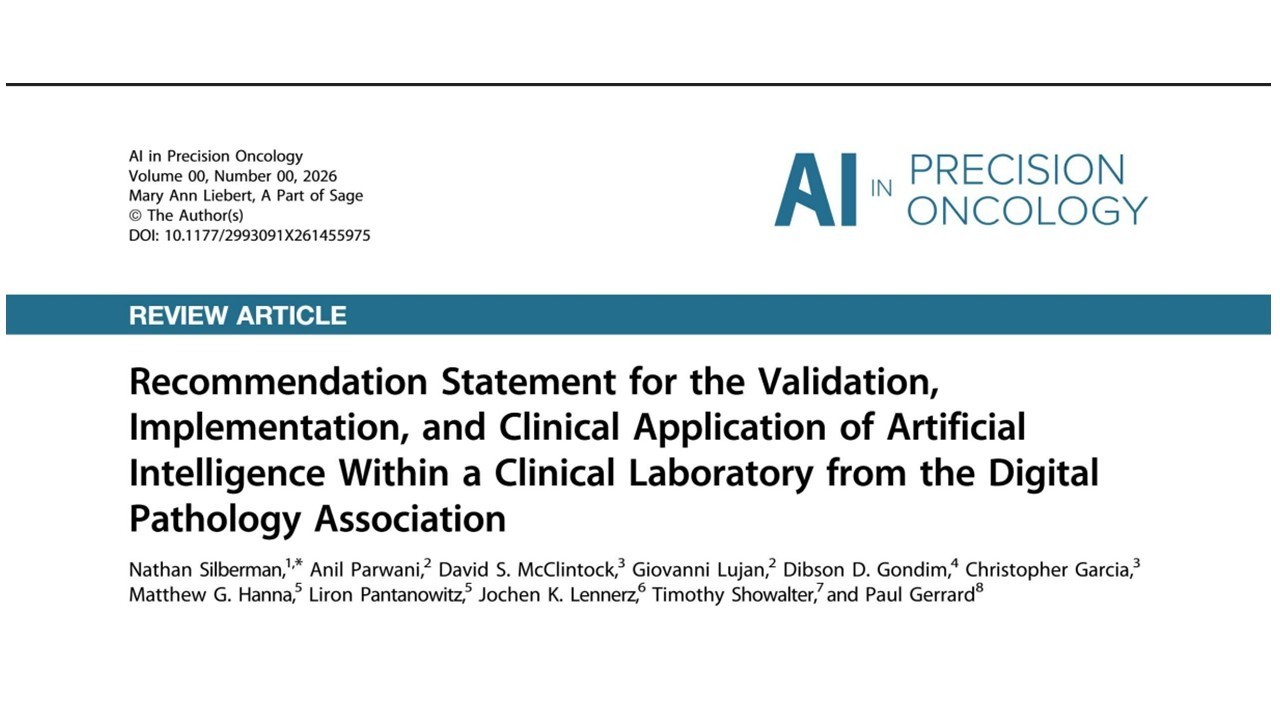
This week, the Digital Pathology Association released a comprehensive recommendation statement on the validation, implementation, and clinical application of artificial intelligence in digital pathology. What struck me was not what was new, but what it quietly confirmed. The document is nominally about artificial intelligence. What it really describes is the operating environment required for precision medicine.
Three recommendations reveal just how much the conversation has changed.
1. Variability
The first concerns scanner variability. The article is explicit: algorithm performance depends on the scanner on which it is deployed, and validation must be demonstrated for each platform. This is more than a technical consideration and an acknowledgment of operational reality. Hospitals rarely operate identical hardware, workflows, or laboratory environments, and precision medicine must succeed despite that variability, not because it has been eliminated.
2. Oversight
The second concerns pathologist oversight. The recommendation is unequivocal: AI augments clinical expertise but does not replace it. In daily practice, this feels less like a regulatory requirement than a recognition of clinical reality. While AI excels at narrowly defined tasks, pathologists must integrate morphology, clinical history, molecular findings, rare disease patterns, and diagnostic judgment that no training set fully anticipates. The future is not autonomous diagnosis. It is intelligently augmented expertise.
3. Clinical Utility
The third concerns clinical utility, and this is where the bar is raised most significantly. A high-performing model is not enough. Clinical utility requires evidence that using the result actually changes patient management and improves outcomes. In dermatopathology, where a melanoma grading decision can determine treatment intensity, that distinction is not abstract. It moves the conversation beyond developing algorithms to delivering measurable clinical value, and that is a fundamentally harder problem.
Taken together, these recommendations describe something much larger than AI governance. They describe the infrastructure required for intelligence to become healthcare.
We have seen this pattern before. GPS technology existed for decades, yet it did not transform everyday life simply because satellites became more accurate. It became indispensable only when maps, smartphones, cloud computing, wireless networks, and real-time traffic data converged into a seamless ecosystem. The breakthrough was not a better satellite. It was the infrastructure that allowed millions of people to benefit from the intelligence those satellites had been generating all along. Precision oncology is approaching a similar inflection point. The biomarkers exist, the algorithms exist, and our biological understanding continues to expand. What remains inconsistent is the operational layer that validates performance across diverse environments, orchestrates workflows, connects fragmented systems, governs quality, and delivers the right intelligence at the precise moment a clinical decision must be made.
The conversation is evolving. We are moving from asking “Can AI detect disease?” to asking “What system ensures that AI improves care, every case, every day?” That is a much more difficult question, and it is the one that will determine whether precision medicine scales beyond a handful of highly resourced institutions or becomes accessible to patients everywhere.
Discovery will continue to accelerate. But the breakthroughs that matter are the ones that become routine, and that requires infrastructure, execution, and a field willing to treat delivery as seriously as discovery.
About the Author
Dr. Rajendra Singh is a Professor of Pathology at the University of Pennsylvania and co-founder of PathPresenter. He serves as a member of the Digital and Computational Pathology Committee of the CAP, Editorial Board of the WHO for Classification of tumors, 5th Edition and the Board of Digital Pathology Association.
More Posts
- Primaa and PathPresenter Introduce Fully-Integrated AI Workflows for Dermatopathology
- The Proof Problem, Part 1: AI Isn’t Replacing Our Job. It’s Adding a New One.
- The Business of Pathology: Unlocking a Lab’s Value
- Expanding Access to Hantavirus Education: Sharing Images Through the PathPresenter Public Library
- The Future of Pathology Part 3: The Delivery Problem and the Infrastructure of Intelligence