
Expanding Access to Hantavirus Education: Sharing Images Through the PathPresenter Public Library
Wednesday July 8, 2026
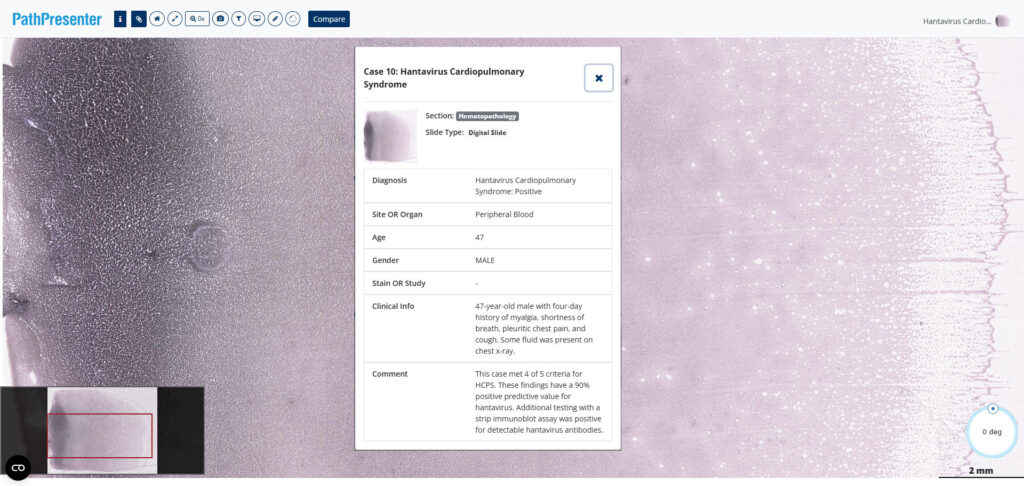
Hantavirus is a rare but serious infection, and the recent headline-grabbing surge in cases around the world highlights the importance of timely diagnosis in preventing its spread. Recognition of hantavirus may begin with clinical teams seeing symptoms, but pathologists and laboratory professionals play a key role in identifying subtle morphologic features in peripheral blood smears, leading to confirmatory testing and patient management. With this in mind PathPresenter is proud to highlight the work of Dr. Joseph Stenberg, a resident at the University of New Mexico School of Medicine, who is sharing an educational series focused on hantavirus cardiopulmonary syndrome (HCPS) screening in peripheral blood smear cases.
The project comprises 10 hand-selected cases by Dr. Kathryn Foucar, Distinguished Professor at the University of New Mexico, and includes whole slide images (WSIs) representing a broad spectrum of diagnostic presentations. These include classic examples of HCPS, borderline cases, early-evolving infections, and negative mimics that challenge learners to distinguish subtle findings from true disease.
By sharing cases across this diagnostic spectrum, Dr. Stenberg aims to create a valuable educational resource for pathology trainees, practicing pathologists, and other laboratory medicine professionals seeking to improve their recognition of hantavirus-related findings in peripheral blood smears.
Bringing Interactive Learning to Published Medical Education
A key goal of the project is to allow learners to do more than simply view static images. To maximize educational value, Dr. Stenberg is using PathPresenter to provide an interactive slide-viewing experience.
“This project was built around a simple goal: to make high-quality educational cases of hantavirus cardiopulmonary syndrome freely available to anyone, anywhere” said Dr. Stenberg. “By providing unrestricted access to complete digital slides through PathPresenter, we hope to help laboratory professionals become more confident in recognizing this rare but life-threatening syndrome. Earlier recognition can lead to earlier diagnosis, more timely clinical intervention, and ultimately better patient care.”
Rather than relying on selected screenshots or figure panels alone, learners can explore the complete digital slides themselves, zooming and navigating through the specimens just as they would at a microscope. This approach allows users to appreciate subtle findings, evaluate areas of interest independently, and gain experience that more closely resembles real-world diagnostic practice.
To make the cases as accessible as possible, Dr. Stenberg has generously donated de-identified slides to the PathPresenter Public Library. The slides will also be linked from his forthcoming publications (both online and in print), allowing readers to move seamlessly between published educational content and the original digital pathology slides.
A Great Example of Community Contribution
Dr. Stenberg’s project exemplifies one of the core purposes of the PathPresenter public platform: creating a collaborative learning community where educators and learners can contribute to the advancement of pathology education.
Any PathPresenter public user can share de-identified educational material with the community. Contributions from individual pathologists, trainees, academic institutions, and professional organizations collectively help build a richer and more diverse educational ecosystem.
Many users are familiar with PathPresenter’s highly popular High Yield Cases, which are curated and annotated by distinguished pathologists and serve as valuable study resources for residents preparing for board examinations. But the continued growth and success of the platform is driven by contributions from across the pathology community.
Today, the PathPresenter public platform includes more than 85,000 users and over 10,000 slides, representing a broad range of subspecialties, diseases, and educational approaches. Every new contribution helps expand the breadth of learning opportunities available to pathologists around the world.
A Valuable Resource for Hematopathology Education
The HCPS cases contributed by Dr. Stenberg consist of blood smear (hematopathology) images scanned at 40× magnification, providing the resolution needed to examine important cellular details and morphologic features.
Because the collection includes both classic and challenging presentations, it offers learners an opportunity not only to recognize hallmark findings but also to develop diagnostic judgment in cases where the answer may not be immediately apparent. These are often the cases that provide the greatest educational value and most closely reflect real-world practice.
As his cases are published, they will serve as a useful bridge between traditional academic publication and interactive digital pathology education.
Thank You, Dr. Stenberg
PathPresenter salutes Dr. Stenberg and his colleagues for this valuable contribution to publicly available medical knowledge. By sharing these cases with the pathology community, they are helping create resources that will benefit learners and educators far beyond their own institution.
We look forward to sharing links to Dr. Stenberg’s published articles in the near future and will post updates here on the PathPresenter blog as they become available.
In the meantime, if you’d like to explore the slides yourself, visit the PathPresenter Public Library and search for “hantavirus.” If you don’t already have one, you can create a free account which includes 10 GB of storage for your own uploads.
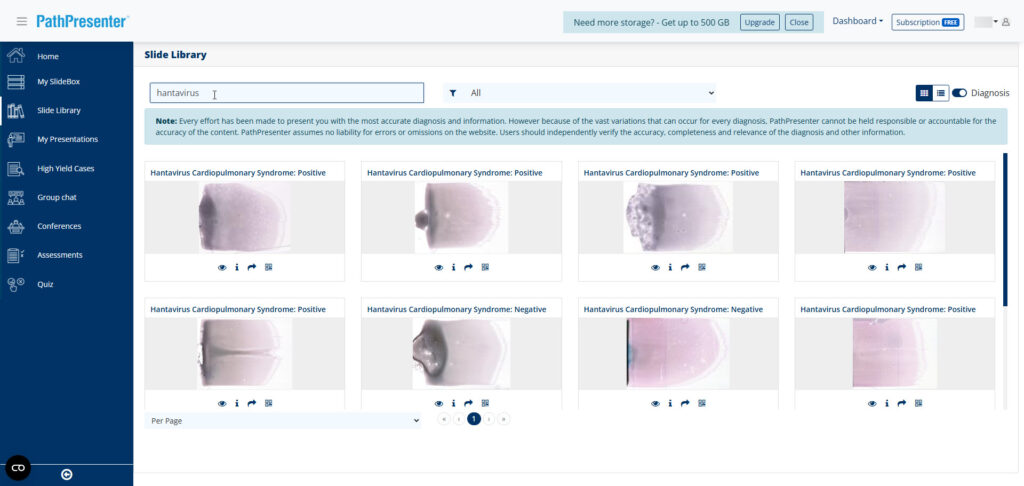
We encourage educators, trainees, and practicing pathologists alike to take advantage of these interactive teaching materials—and to consider contributing their own educational cases to help strengthen the global learning community.
More Posts
- PathVisions2026 Workshop: How Leading Centers Are Building Connected Pathology Workflows with PathPresenter
- PathPresenter co-Founder Dr. Rajendra Singh named to The Pathologist’s Power List 2026
- Primaa and PathPresenter Introduce Fully-Integrated AI Workflows for Dermatopathology
- The Proof Problem, Part 1: AI Isn’t Replacing Our Job. It’s Adding a New One.
- The Business of Pathology: Unlocking a Lab’s Value