What ASCO Taught Me About the Future of Pathology
Wednesday June 3, 2026

by Rajendra Singh MD
Professor of Pathology, University of Pennsylvania
Co-Founder, PathPresenter
A field report from the world’s largest oncology meeting—and a call to my fellow pathologists.
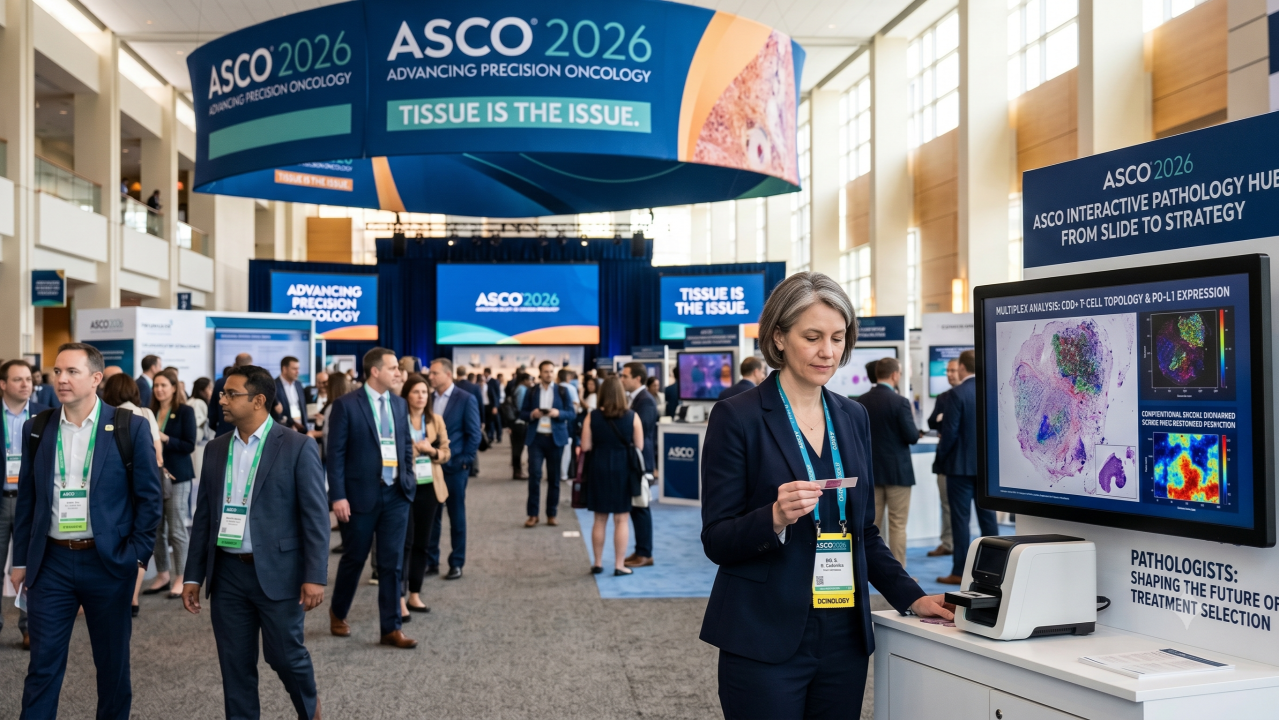
This weekend, I joined tens of thousands of oncologists, researchers, pharmaceutical executives, and data scientists at the ASCO Annual Meeting. The entire cancer medicine ecosystem was gathered in one place.
Yet among the thousands of people discussing the future of cancer care, I could count the pathologists on two hands.
I sat through presentations on antibody-drug conjugates (ADCs), immunotherapy combinations, spatial biomarkers, and novel companion diagnostics. Different diseases. Different companies. Different therapeutic strategies. Yet I found myself writing the same note repeatedly in the margin of my notebook:
This depends on pathology.
The more I listened, the more obvious it became that many of oncology’s biggest challenges are no longer drug problems. They are patient-selection problems. And patient selection begins with understanding tissue.
The industry is chasing the biology that pathologists have spent their careers studying.
For the first time in my career, I believe pathology is positioned not only to diagnose disease, but to help determine treatment.
1. The Industry Is Chasing Tissue Biology
No matter the disease or the drug class, the central question in oncology today is patient selection. Who will respond? Who will benefit? Who should receive this therapy?
Whether the discussion involved checkpoint inhibitors, ADCs, or cellular therapies, the answers do not live in a liquid biopsy or a genomic sequence alone. They live in tissue architecture inside the tumor microenvironment, within the spatial relationships between malignant cells and immune infiltrates.
The answers oncologists are looking for reside in tissue. And that means pathology must be at the table.
2. The H&E Slide Is Far Richer Than We Imagined
The glass slide sitting under our microscopes contains a vast reservoir of unextracted information. Spatial arrangements of immune cell subsets, subtle variations in stromal organization, cellular heterogeneity across a specimen are not incidental features. They are biological signals that influence treatment response and clinical outcomes.
Digital pathology, computational modeling, multiplex imaging, and AI allow us to quantify what was previously qualitative, transforming what we have always observed into measurable, reproducible biological data.
These technologies are not replacing the pathologist’s eye. They are extending its reach. This is not a disruption to pathology; it is pathology at greater resolution.
3. Pathology’s Second Act: From Diagnosis to Treatment
For most of my career, pathology has answered the first question in cancer care: What disease does this patient have? Oncology is now asking a second question: What treatment is most likely to help this patient?
That question increasingly depends on information embedded within the tissue itself:
- Why does one patient respond to immunotherapy while another progresses?
- Which features of the tumor microenvironment predict resistance?
- What makes a targeted therapy effective in one patient and ineffective in another?
These are pathology questions. And they are among the most consequential questions in medicine today.
4. Why Pathologists Must Lead
No algorithm inherently understands tissue biology. No software comprehends the clinical weight of a diagnostic error. Pathologists do. That is precisely why we must be the ones evaluating, validating, and challenging these tools, separating what is biologically meaningful from what is merely statistically interesting.
The pathologist of the next decade will need an expanded toolkit. We must learn how to interpret spatial biology, understand AI-derived biomarkers, engage with computational pathology, and participate in the development of the next generation of companion diagnostics. This is not about abandoning what we know; it is about building on it.
The future of oncology cannot be built by software engineers or clinical oncologists alone. It requires pathologists who speak both the language of tissue and the language of data.
The future of pathology will not be determined by artificial intelligence. It will be determined by whether pathologists choose to engage with it.
The tools are changing. The mission is not.
Defining the Future
When I return to ASCO next year, I hope I need more than two hands to count the pathologists in attendance. Not because we are defending our relevance, but because we are helping shape the future of cancer care.
The future of precision oncology is being built now.
And pathology belongs at the center of it.
About the Author
Dr. Rajendra Singh is a Professor of Pathology at the University of Pennsylvania and co-founder of PathPresenter. He serves as a member of the Digital and Computational Pathology Committee of the CAP, Editorial Board of the WHO for Classification of tumors, 5th Edition and the Board of Digital Pathology Association.
More Posts
- Primaa and PathPresenter Introduce Fully-Integrated AI Workflows for Dermatopathology
- The Proof Problem, Part 1: AI Isn’t Replacing Our Job. It’s Adding a New One.
- The Business of Pathology: Unlocking a Lab’s Value
- Expanding Access to Hantavirus Education: Sharing Images Through the PathPresenter Public Library
- The Future of Pathology Part 3: The Delivery Problem and the Infrastructure of Intelligence